
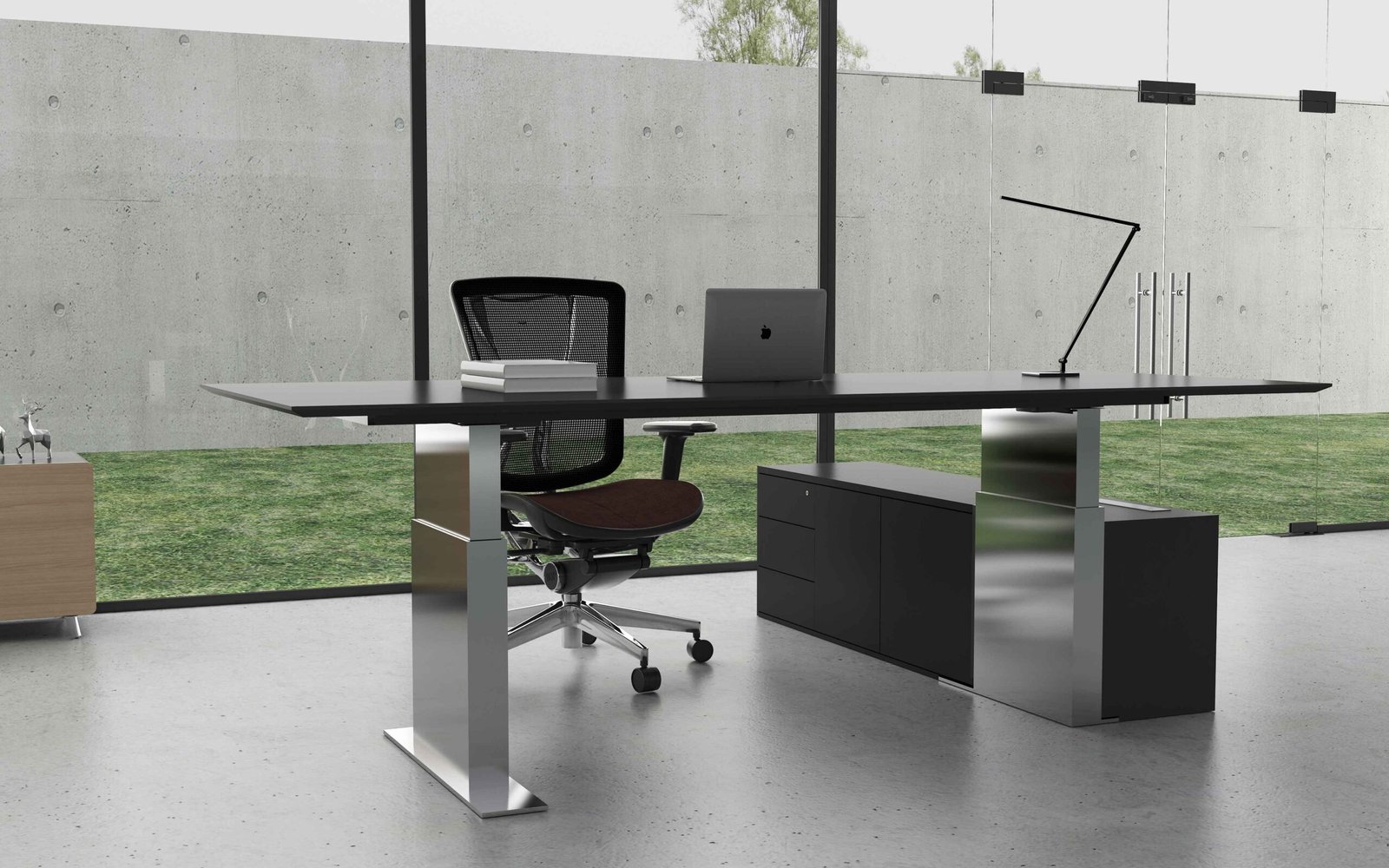
Height-adjustable desks are now common in modern offices, but specifying them for a commercial project involves more than choosing a desk that moves up and down.
When dozens or hundreds of desks are being installed across a workplace, buyers also need to think about stability, furniture layout, cable movement, desktop size, frame compatibility, installation, maintenance and consistency across the project.
This makes height-adjustable furniture a different procurement decision from a standard fixed desk.
For distributors, designers, contractors and procurement teams, the useful question is not simply:
“Should we buy sit-stand desks?”
It is: “Where does height adjustment create real value in this project, and what needs to be confirmed before the desks are manufactured?”
NORDA’s current height-adjustable desk range includes solutions for executive offices, conference settings and other commercial workspace applications.
Not Every Desk Needs to Be Height Adjustable
One of the first decisions should be where adjustment is actually useful.
Commercial buying guides increasingly treat sit-stand desks as an important part of modern workplace planning, particularly for desks used for long periods or shared by different users. At the same time, fixed-height furniture may remain perfectly suitable for short-use meeting, training or touchdown areas.
That means a project does not necessarily need to specify the same desk mechanism everywhere.
Height adjustment is particularly relevant for:
- individual workstations used for long periods
- shared or hot-desking environments
- executive offices
- employees with different ergonomic requirements
- flexible workspace programs
- areas where the same furniture needs to accommodate different users
Fixed desks may still make sense for:
- short training sessions
- occasional meeting areas
- visitor desks
- touchdown spaces
- furniture where adjustment adds little practical benefit
The right solution may therefore be a mixed furniture plan, rather than converting every table in the building into a sit-stand desk.
Start With the User and Workspace
Before selecting a mechanism, define how the desk will be used.
Important questions include:
- Is the desk assigned to one person or shared?
- How many hours per day will it be used?
- What equipment will sit on the desktop?
- Will the user have one monitor or several?
- Does the desk include storage?
- Does the project require a return or side cabinet?
- Is the desk positioned against a wall or in an open workstation?
- How will power and data reach the desk?
These questions affect the furniture configuration more than the appearance alone.
A height-adjustable executive desk may need to coordinate with a cabinet or return.
A shared workstation may need a simpler structure that can be repeated many times across a floor.
A conference table with height adjustment creates a different technical problem again.
Recommended image here: use a real NORDA height-adjustable executive desk or workstation application image already used on the website.
Stability Matters More at Standing Height
A desk that feels stable while seated may behave differently when raised.
This is one reason commercial buying guides repeatedly highlight stability as a core evaluation point for sit-stand furniture.
At standing height, buyers should consider:
- lateral movement
- front-to-back movement
- frame rigidity
- leg geometry
- foot design
- desktop size
- distribution of equipment
- connection between the frame and tabletop
This becomes more important when the desk carries:
- several monitors
- monitor arms
- computers
- desktop power modules
- storage accessories
- heavier worktops
Do not evaluate a height-adjustable desk only in its lowest position.
For larger projects, the representative sample should be tested at the heights users will actually work at.
Do Not Compare Frames Only by Motor Count
Motor configuration can be useful information, but it should not become the only measure of quality.
The overall performance of a height-adjustable desk depends on the complete system:
- lifting columns
- frame construction
- synchronization
- control system
- structural geometry
- tabletop size
- load distribution
- installation quality
A supplier may offer different mechanisms for different products or project requirements.
Unless the exact technical configuration has been confirmed for the specific NORDA model, buyers should not assume that every product uses the same motor or control system.
The better approach is to ask for the technical specification of the exact product being quoted.
Check the Working Height Range Against Real Users
A height-adjustable desk should work for the people who will actually use it.
For shared workplaces, the range may need to accommodate users with significantly different heights.
For private executive offices, the requirement may be more focused but still needs to work with:
- chair height
- user posture
- monitor position
- desktop thickness
- keyboard and input devices
The precise adjustment range should come from the confirmed product specification.
Do not assume that two visually similar height-adjustable desks have the same travel range.
For B2B procurement, this is especially important when different desk structures are being combined within one project.
Think About the Entire Desk, Not Just the Lift Frame
The lifting mechanism is only one part of the product.
A commercial height-adjustable desk may also include:
- stainless steel or metal frame elements
- desktop
- side cabinet
- return
- modesty panel
- cable-management components
- desktop power modules
- control unit
- storage
These components need to work together while the desk changes height.
A cabinet positioned incorrectly can restrict movement.
A cable tray with insufficient slack can create tension.
A side return may require a different structural solution from a simple rectangular desk.
This is why Height Adjustable Executive Desks should be reviewed as complete furniture systems rather than just adjustable bases.
Cable Management Must Move With the Desk
Cable management is one of the most practical differences between fixed and height-adjustable furniture.
When the desktop moves, the cables connected to it also move.
The project needs enough flexibility for:
- power cables
- monitor cables
- network cables
- charging cables
- desktop power modules
- control cables
At the same time, excess cable should not hang visibly or create a snagging risk.
A useful planning sequence is:
building power → floor or wall connection → furniture cable path → moving desktop → user equipment
If any part of that path is too short, too rigid or poorly positioned, the desk may work correctly at seated height but create problems when raised.
Cable planning should therefore happen before production, not after installation.
Integrated Desktop Power Needs Extra Coordination
Many commercial offices now want power and charging access built directly into the furniture.
For adjustable desks, the socket and desk need to be reviewed together.
NORDA’s Desktop Power Socket range includes different integration directions for commercial office furniture.
Before selecting one for a height-adjustable desk, confirm:
- installation position
- cut-out requirements
- clearance below the tabletop
- cable movement
- interaction with the frame
- destination electrical requirements
Do not assume a socket that works in a fixed conference table will automatically work in an adjustable desk.
The moving structure may create different clearance and cable requirements.
Desktop Size Changes the Technical Requirement
A larger tabletop can influence:
- stability
- frame span
- load distribution
- cable length
- storage position
- visual proportions
For commercial projects, the desktop should not be selected independently of the adjustable frame.
If a project requests a wider or deeper worktop, the supplier should confirm whether the chosen frame configuration supports it.
This is particularly important when buyers want to customize:
- executive desks
- L-shaped desks
- conference tables
- desks with cabinets
- oversized work surfaces
Customization is possible only when the structure and mechanism can support the final configuration.
Storage Requires More Care Than on a Fixed Desk
Storage can complicate a height-adjustable desk.
A mobile pedestal positioned under the desk may interfere with downward movement.
A fixed side cabinet may require the moving desktop and stationary storage to be separated correctly.
An integrated cabinet may require a dedicated structure.
Project teams should clarify whether storage is:
- attached to the moving desk
- fixed independently
- mobile
- part of a side return
- part of an executive configuration
This is especially important for executive furniture, where buyers often want both height adjustment and substantial storage.
The final layout should be confirmed before production rather than improvised during installation.
Shared Desks Need Simpler User Interaction
Height-adjustable desks can be particularly useful in shared workplaces because different users can adapt the desk to their preferred position.
However, shared furniture also needs to be intuitive.
A complicated control system may look sophisticated but provide little value if employees do not know how to use it.
For shared environments, consider:
- easy adjustment
- clear controls
- quick user setup
- cable organization
- monitor positioning
- consistency across desks
Commercial workplace planning examples also use height-adjustable desks as part of flexible and ergonomic private-office and shared-work settings.
The goal is not technology for its own sake.
It is making the furniture easier for different people to use.
Standardization Helps With Large Rollouts
When a project contains many adjustable desks, standardization becomes valuable.
Using a consistent frame and desktop strategy can simplify:
- drawings
- production
- installation
- replacement parts
- future reconfiguration
- user experience
Bulk-office procurement guides often emphasize that specification consistency becomes increasingly important as quantities rise because mistakes multiply quickly across a floor.
That does not mean every desk must look identical.
A project can maintain the same technical platform while varying:
- desktop dimensions
- finishes
- storage
- office application
- workstation layout
This can provide visual flexibility without creating unnecessary technical complexity.
Sample Testing Is Especially Useful for Adjustable Furniture
A sample can reveal issues that are difficult to judge from a drawing.
Before a larger order, test:
- stability while seated
- stability while standing
- lifting movement
- control response
- cable movement
- desktop size
- storage clearance
- power integration
- overall proportions
- installation process
If the project includes several configurations, the most technically complex representative model is often the best one to test first.
Finding one problem in a sample is much easier than discovering the same problem after 100 desks have been installed.
Think About Serviceability
Commercial furniture is expected to remain in use for years.
For adjustable desks, buyers should therefore consider what happens if a component needs attention later.
Useful questions include:
- Can the lifting system be serviced?
- Are major components replaceable?
- Can the controller be accessed?
- Can the desk be disassembled without damaging the worktop?
- Are cables accessible?
- Can replacement components be supplied?
Serviceability is one of the areas where commercial-grade products can differ from furniture designed only for occasional home use.
Recent procurement guidance similarly emphasizes long-term reliability and serviceability rather than evaluating adjustable desks only on first-day appearance.
Packing and Installation Need to Match the Project
Height-adjustable desks contain more components than many fixed desks.
Depending on the product, a shipment may include:
- tabletop
- frame
- lifting columns
- feet
- control components
- fasteners
- cable-management parts
- storage
- accessories
For international projects, buyers should clarify:
- package count
- labeling
- hardware organization
- assembly instructions
- site installation responsibility
- replacement parts
- container loading where required
Clear product identification becomes especially important when multiple desk configurations arrive in the same shipment.
What Should Buyers Include in an RFQ?
For a useful quotation, provide as much project context as possible.
This may include:
- required quantity
- desk type
- intended application
- destination country
- target desktop dimensions
- preferred finish
- storage requirement
- power requirement
- workstation layout
- executive-office layout
- target delivery date
- floor plans or furniture drawings
If the technical specification is still being developed, the supplier can identify which details need to be confirmed before production.
A clear RFQ reduces the risk that buyer and manufacturer are quoting different products.
Questions to Ask Before Approving a Height-Adjustable Desk
Before final approval, ask:
- Is the desk intended for the correct office application?
- Is the confirmed adjustment range suitable for intended users?
- Has the structure been checked at standing height?
- Is the desktop size compatible with the frame?
- Is storage positioned safely?
- Has cable movement been planned?
- Does the desktop power module fit the moving structure?
- Are the actual technical specifications confirmed?
- Has a representative sample been tested if required?
- Are packing and installation requirements clear?
If these questions have answers, the product is much closer to being project-ready.
Final Thoughts
Height-adjustable desks can support more flexible, ergonomic and adaptable commercial workplaces, but they should be specified as complete furniture systems rather than treated as a simple upgrade to a fixed desk.
The mechanism, frame, desktop, storage, cables, power and workspace layout all need to work together.
For commercial projects, the safest approach is to decide where height adjustment creates value, confirm the technical configuration of the exact product, and test the complete furniture setup before large-scale production.
Explore NORDA’s Height Adjustable Desk collection and the current Height Adjustable Executive Desk for project applications.
For quotations, buyers can also contact NORDA with quantities, layouts, dimensions, finish requirements and project information.