Choosing an office phone booth is not simply a question of buying the largest model that fits the budget.
The right size depends on what people will actually do inside the booth, how often it will be used, how much floor area is available and whether the space is intended for private calls, one-to-one conversations or small team meetings.
In many open offices, buying the wrong mix of booth sizes creates one of two problems:
the booth is too small for the work people want to do, or a large meeting pod occupies valuable floor space while being used most of the day by only one person.
That is why capacity should be one of the first decisions in an acoustic phone booth project.
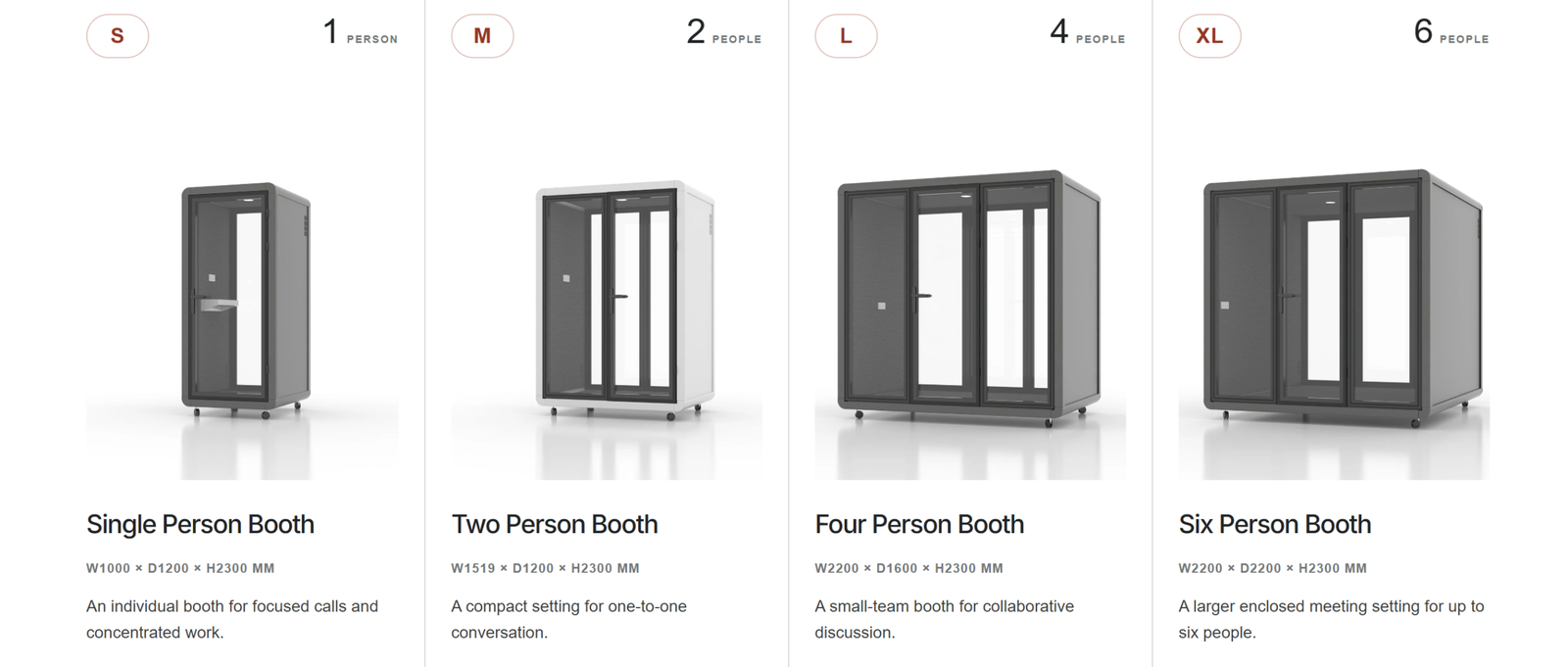
NORDA currently offers four capacities:
- S — 1 person
- M — 2 people
- L — 4 people
- XL — 6 people
Each serves a different workplace role.
Quick Comparison: S, M, L and XL
| Model | Capacity | External Dimensions | Typical Use |
|---|---|---|---|
| S | 1 person | W1000 × D1200 × H2300 mm | Private calls, video meetings, individual focus |
| M | 2 people | W1519 × D1200 × H2300 mm | One-to-one meetings, interviews, focused discussion |
| L | 4 people | W2200 × D1600 × H2300 mm | Small team meetings and collaborative discussion |
| XL | 6 people | W2200 × D2200 × H2300 mm | Larger enclosed meetings and project conversations |
These are the confirmed external dimensions of the current NORDA booth range.
The important point is that capacity increases differently from footprint.
Moving from S to M adds width while keeping the same depth. Moving to L increases both width and depth. XL keeps the same width as L but adds substantially more depth.
So the decision should be based on both number of users and available floor space.
S — Best for Private Calls and Individual Focus
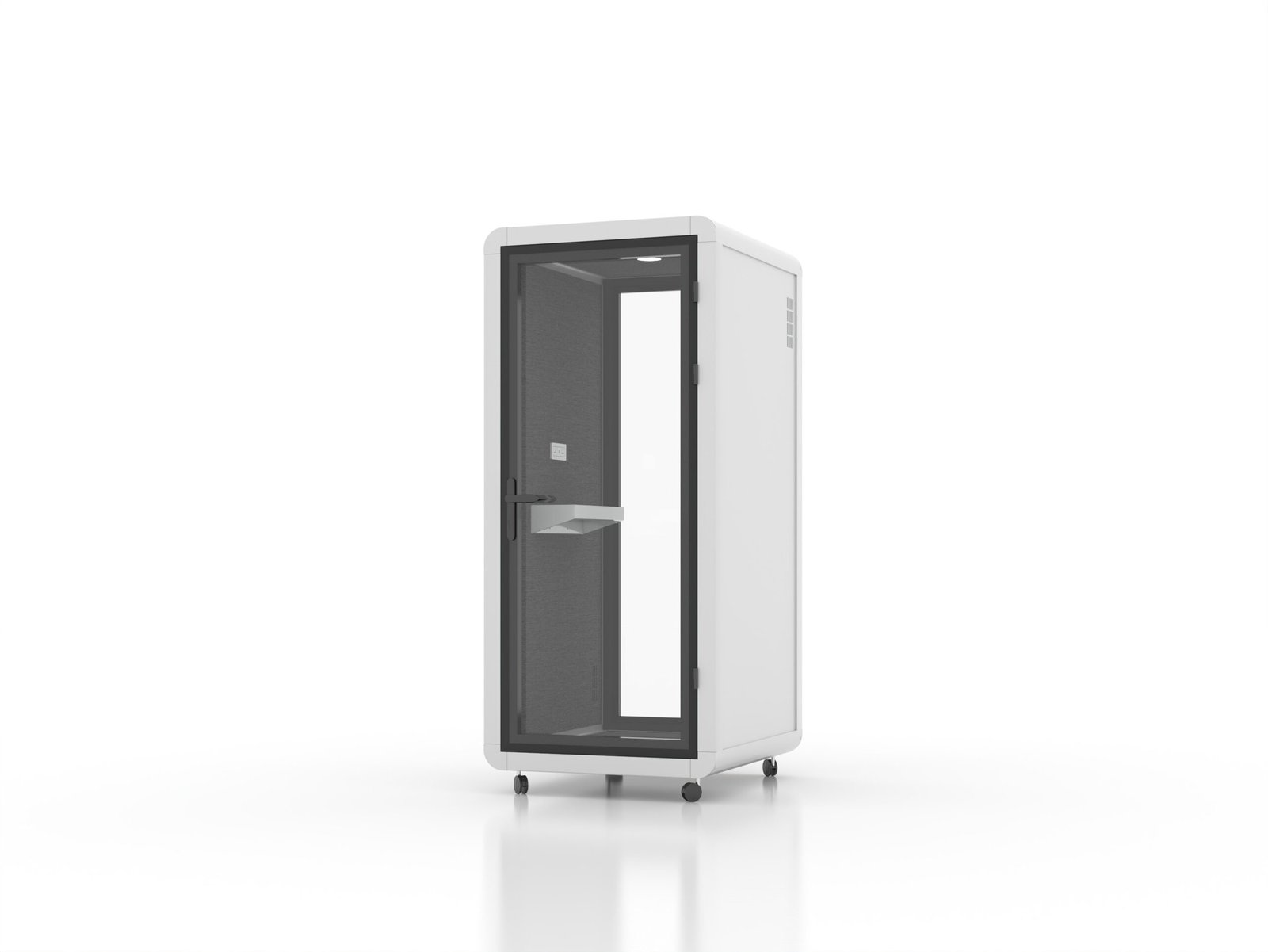
The S Single Person Acoustic Phone Booth is the most compact model in the range.
Its external dimensions are:
W1000 × D1200 × H2300 mm.
This makes S the most suitable starting point when the main requirement is giving individual employees somewhere to step away from the open office.
Typical uses include:
- private phone calls
- video meetings
- online interviews
- confidential conversations
- individual focused work
- short periods of concentration away from desk noise
For many open-plan offices, this is the booth type that may be needed in the greatest quantity.
A common planning mistake is using a large meeting pod for tasks that only require one person. That consumes more floor area than necessary and can make the larger booth unavailable when a team actually needs it.
If most demand comes from individual calls, several S booths distributed across the workplace may be more practical than one large pod.
Recommended image: use the real S booth open-office application image already shown on the S product page.
M — Best for One-to-One Meetings
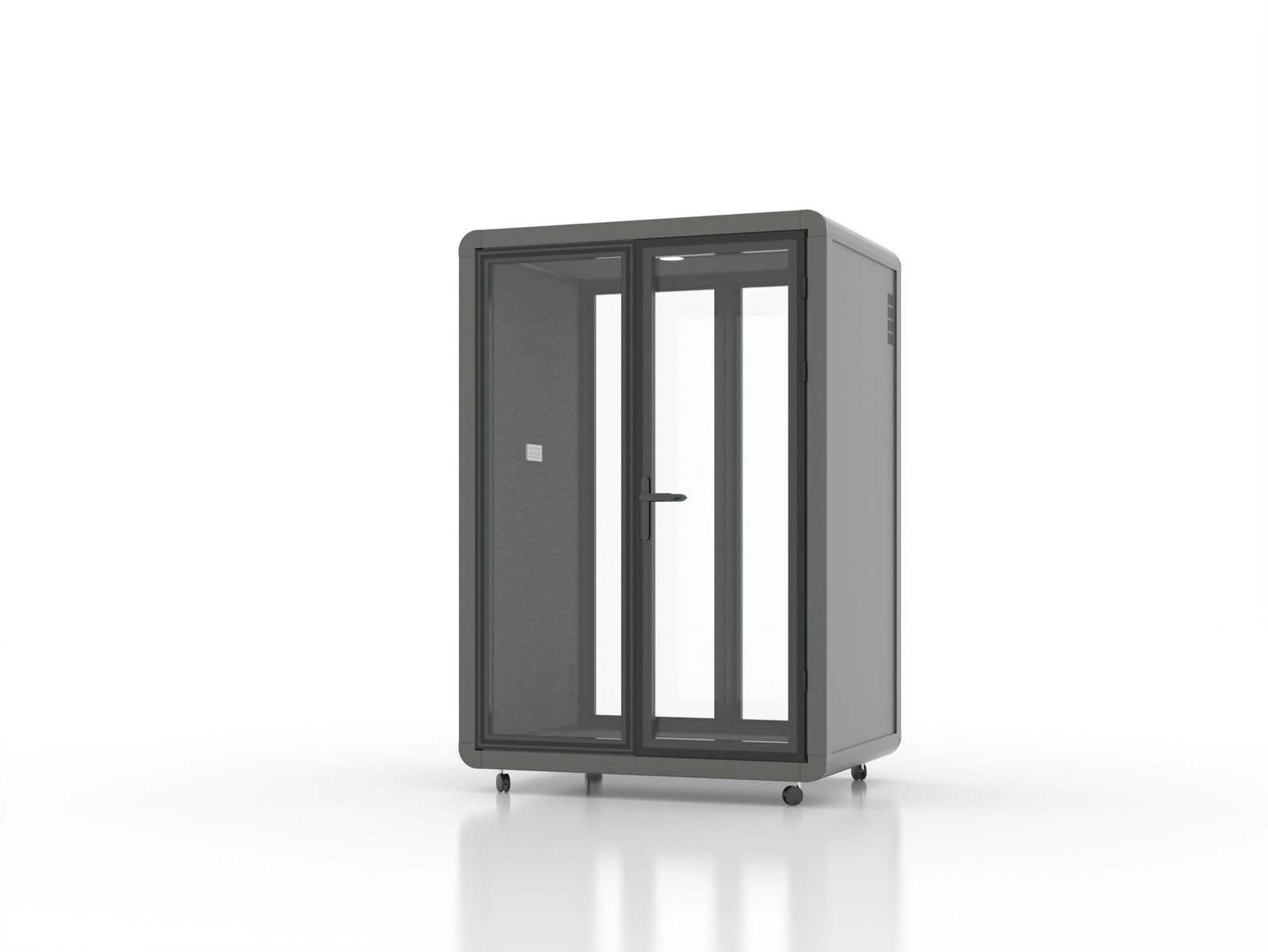
The M Two Person Acoustic Phone Booth is designed around two-person use.
External dimensions:
W1519 × D1200 × H2300 mm.
Compared with S, the additional width creates room for a second user without moving directly into a much larger meeting-room footprint.
M is better suited to:
- one-to-one meetings
- interviews
- manager and employee conversations
- short design reviews
- sales discussions
- paired laptop work
- confidential HR conversations
For workplaces where meeting rooms are frequently booked by only two people, a two-person pod can help move those smaller conversations out of larger conference rooms.
This is particularly useful when meeting-room capacity is limited.
The key question is not simply whether two people can physically fit inside.
Project teams should consider how long people will remain inside, whether they need a table, whether laptops will be used and how the booth will be positioned relative to circulation routes.
L — Best for Small Team Collaboration
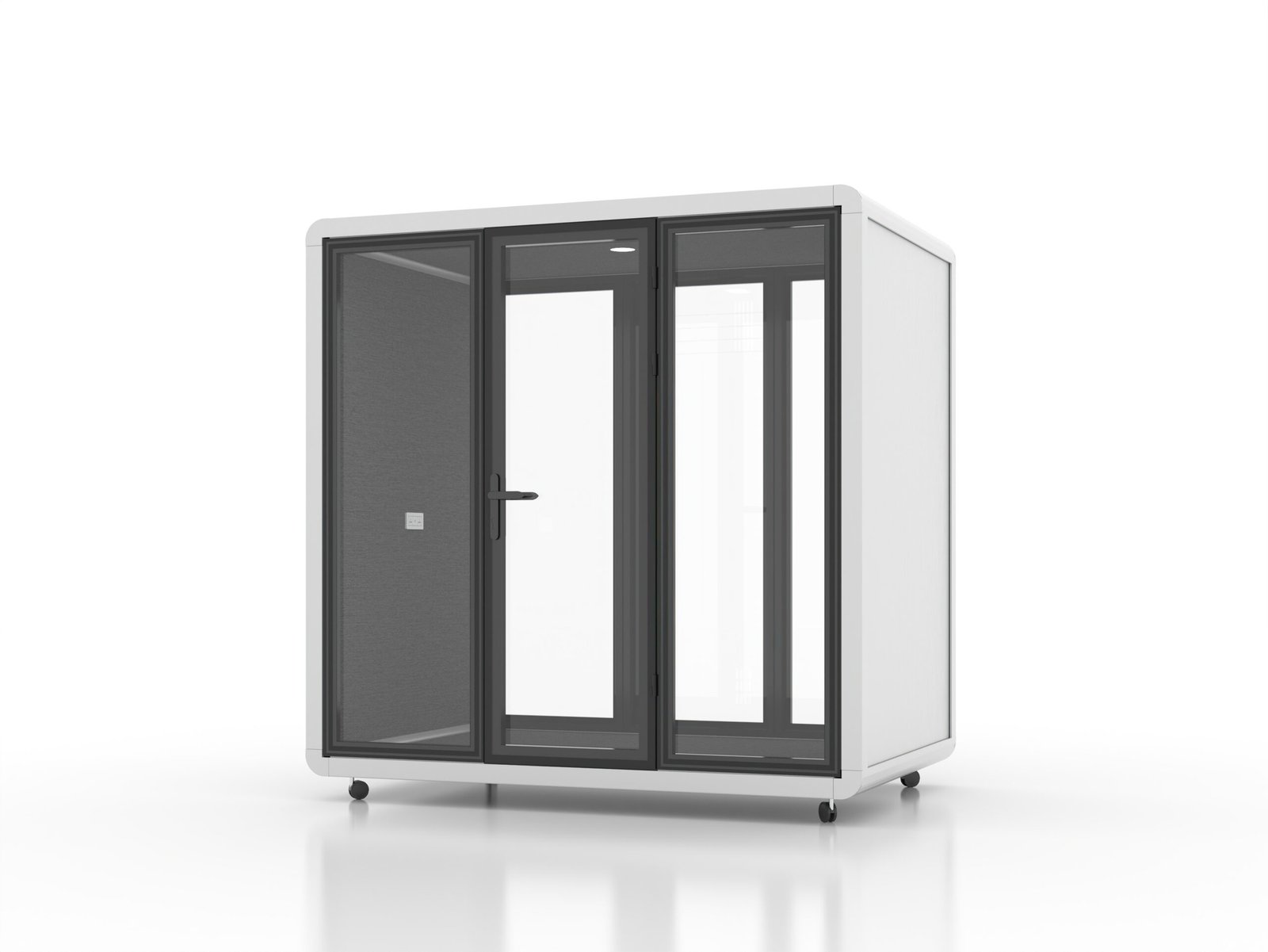
The L Four Person Acoustic Phone Booth moves from private conversation into genuine small-group collaboration.
External dimensions:
W2200 × D1600 × H2300 mm.
Typical uses include:
- team huddles
- project discussions
- design reviews
- video meetings
- short client meetings
- collaborative problem-solving
At this size, furniture planning becomes more important.
A four-person booth is no longer just an acoustic enclosure with a shelf. Seating position, table size, circulation inside the booth and ventilation comfort all become part of the usable experience.
For B2B projects, furniture shown in booth photography should not automatically be assumed to be included. The final furniture configuration should be confirmed as part of the project specification.
The L model is often a useful middle ground when a company needs enclosed team space but does not want to construct another permanent meeting room.
XL — Best for Larger Enclosed Meetings
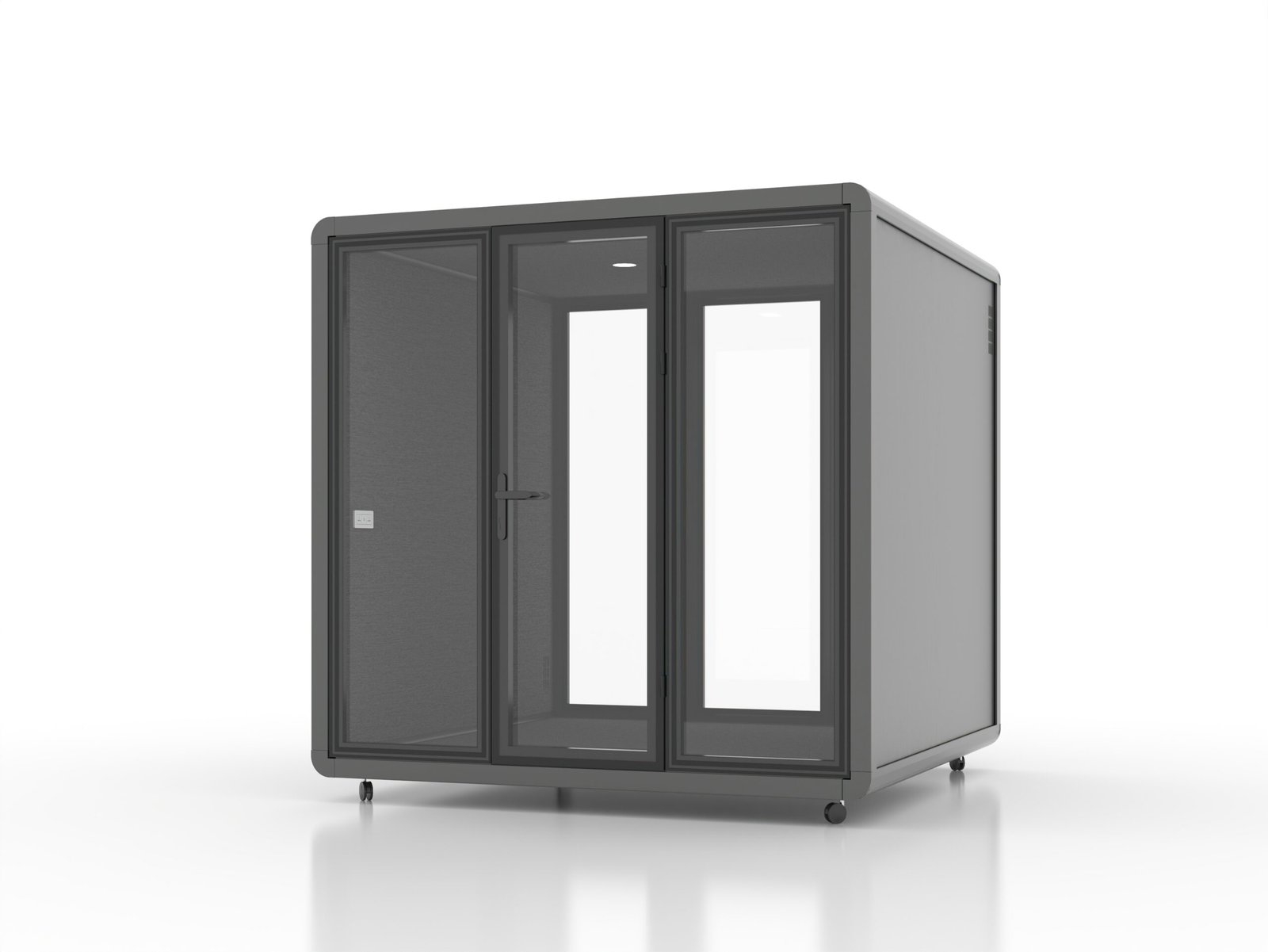
The XL Six Person Acoustic Phone Booth is the largest standard NORDA model.
External dimensions:
W2200 × D2200 × H2300 mm.
It is intended for larger enclosed discussions such as:
- project meetings
- department huddles
- client conversations
- design presentations
- longer collaborative sessions
- meetings that would otherwise require a small permanent conference room
At this scale, buyers should evaluate the pod more like a small room than a phone booth.
Floor placement, ventilation, furniture arrangement, delivery access and installation logistics all become more important.
The XL also differs from the smaller NORDA models in packing: one booth unit is shipped in three packages, rather than one package for S, M or L. The Phone Booth product line page confirms this package-count difference.
For project procurement, that makes delivery planning and installation access worth checking before the order is finalized.
Do Not Choose Capacity by Headcount Alone
The number printed next to the booth model is only the starting point.
A four-person model does not automatically mean it is the correct booth whenever four employees occasionally meet.
Ask what type of work actually happens.
For example:
One person making frequent calls
A large meeting booth is unnecessary. S is usually the more efficient spatial solution.
Two people holding regular confidential conversations
M gives the conversation its own enclosed space without taking the footprint of a team pod.
Four people sharing ideas around a table
L is much more appropriate because the booth needs to support interaction rather than just occupancy.
Six people holding scheduled meetings
XL is the relevant starting point, but the project should also check whether the frequency of those meetings justifies the larger footprint.
Current buying guides in the market similarly emphasize matching pod capacity to actual use rather than simply purchasing the largest available option.
Calculate the Floor Area Before Requesting a Quote
A booth does not only occupy its external footprint.
The surrounding workplace also needs enough room for people to approach, enter and move around it.
Before specifying quantities, check:
- booth external dimensions
- door access
- nearby circulation routes
- wall and column positions
- workstation clearance
- emergency and fire egress requirements
- delivery route
- lift and doorway access
- installation area
Industry sizing guides also recommend considering circulation clearance and door movement rather than treating the product footprint as the entire planning requirement.
This matters especially when several booths are placed together.
Four S booths may use space differently from one XL booth, even if both solutions appear to provide similar total seat capacity.
Think in Terms of a Booth Mix
Many workplaces do not need one booth size.
They need a mix.
For example, an office floor could use:
- several S booths for calls
- one or two M booths for one-to-one meetings
- one L booth for team collaboration
- an XL only where regular six-person enclosed meetings are expected
This approach can reduce pressure on traditional meeting rooms while allowing each booth type to serve the work it was designed for.
The best mix depends on actual workplace behaviour.
Before purchasing a large quantity, it can be useful to observe:
- how often meeting rooms are occupied by one person
- how many private calls happen each day
- how often two-person meetings occur
- whether small project teams struggle to find enclosed space
- peak usage periods
- whether existing meeting rooms are consistently overbooked
That information can be more useful than simply dividing the number of employees by a fixed booth ratio.
Acoustics Are Important, but Size Still Changes the Experience
People often start booth comparisons with acoustic performance.
That matters, but a booth also needs to be comfortable enough for its intended duration and number of users.
As capacity increases, buyers should pay more attention to:
- ventilation
- air circulation
- lighting
- interior furniture
- usable table space
- power access
- seating arrangement
- entry and exit
Current office-pod buying guides repeatedly identify acoustics, ventilation, footprint and power integration as core purchasing factors.
NORDA’s current Phone Booth range combines acoustic construction, ventilation, integrated lighting and workplace power, while final technical and market-specific electrical configurations are confirmed by product and project.
Furniture Should Be Confirmed Separately
One detail is easy to misunderstand when comparing booth photographs.
A photo may show:
- a desk
- bench seating
- chairs
- monitor
- accessories
That does not necessarily mean those items are included as standard.
NORDA currently treats interior furniture as a project option rather than automatically assuming everything visible in the booth photography is included.
For quotation purposes, confirm:
- whether furniture is required
- number of seats
- intended use
- table requirement
- monitor or screen requirement
- power requirement
This avoids a common procurement problem where the buyer and supplier are quoting different scopes.
Consider Delivery and Installation Early
Pods are modular products, but larger models still require practical site planning.
Before ordering, confirm:
- destination
- building access
- freight lift size
- doorway dimensions
- floor access
- final placement location
- installation responsibility
- packaging requirements
The NORDA range is designed around modular components and model-specific packing. S, M and L currently use one package per booth, while XL uses three packages per unit.
For larger projects, this information helps purchasing teams plan receiving and installation before the shipment arrives.
Which NORDA Booth Should You Choose?
A simple starting point is:
Choose S when:
the main need is individual privacy, calls and focused work.
Choose M when:
two-person discussions and one-to-one meetings are common.
Choose L when:
small teams need an enclosed space for collaborative work.
Choose XL when:
the project regularly needs enclosed meetings for up to six people.
If several use cases occur on the same floor, a mixed-capacity plan will usually be more flexible than relying on only one booth size.
Final Thoughts
The right office phone booth size is not necessarily the largest model that fits the floor.
It is the model—or combination of models—that matches how people actually use the workplace.
Start with three questions:
How many people need the space at one time?
What will they do inside it?
How much floor area can the project reasonably allocate?
Then review acoustics, ventilation, power, furniture, delivery and installation around that decision.
You can compare the full NORDA Acoustic Phone Booth range, including:
- S — Single Person Acoustic Phone Booth
- M — Two Person Acoustic Phone Booth
- L — Four Person Acoustic Phone Booth
- XL — Six Person Acoustic Phone Booth
For project quotations, share the required capacities, quantities, destination, finish direction, furniture needs and site conditions with NORDA so the booth mix can be reviewed around the actual workplace.